

Published: April 2026
When Onyx Corporation began planning its new processing plant, the company faced three significant challenges:
-
Growing stockpiles of stone
-
Strict environmental permitting on a limited footprint
-
Strong regional demand for septic and concrete sand
Turning that surplus stone into specification sand guided the development of their new plant.
Today, the Sterling, Massachusetts-based pit features a fully-integrated, closed-loop washing operation that converts excess stone into high-spec, manufactured sand—all without any land-intensive, settling ponds.
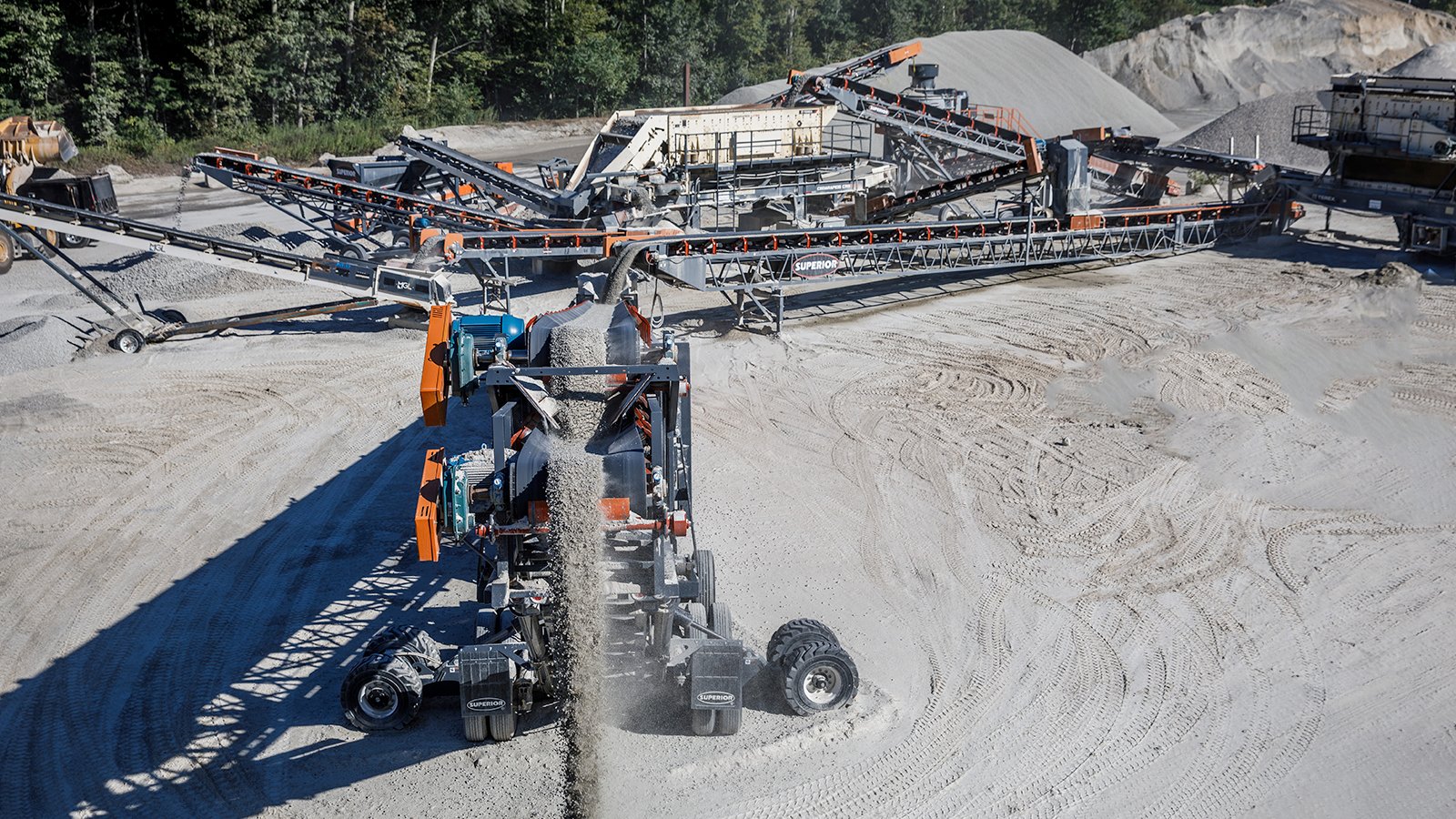 The TeleStacker® Conveyor ties the existing plant to the new wet plant, helping maximize use of the site’s current infrastructure.
Building Sand Capability
“We had never manufactured sand in the history of our company," says John Durkin, president of Onyx. "We wanted to produce a specification with repeatable quality, safety, and efficiency.”
Their other goal was working with a single partner capable of designing, engineering, and delivering the entire system, rather than piecing together multiple suppliers.
“The objective was to take an existing surplus and convert it into a high demand product," says Chris Salafia, a sales engineer at EESSCO. “A lot of producers end up long on stone and short on sand, so this system allows producers to manufacture sand from material they already have.”
Superior led the design and structural engineering, while EESSCO served as the local partner, coordinating equipment supply, integration, and on-site execution.
Designed for Constraints
While the concept seemed simple on paper, execution was not.
The quarry operates within a tightly constrained, suburban footprint, compounded by its location in an aquifer protection zone. Traditional wash plants, often dependent on large settling ponds, were not feasible from either a permitting or land-use standpoint.
“Since permitting large tracts of land for wash plants is tough, everything we did was centered around a compact layout,” says Durkin.
With no place to go, water management became the defining engineering challenge. The plant would need to operate as a closed-loop, keeping water within the system while maintaining production efficiency.
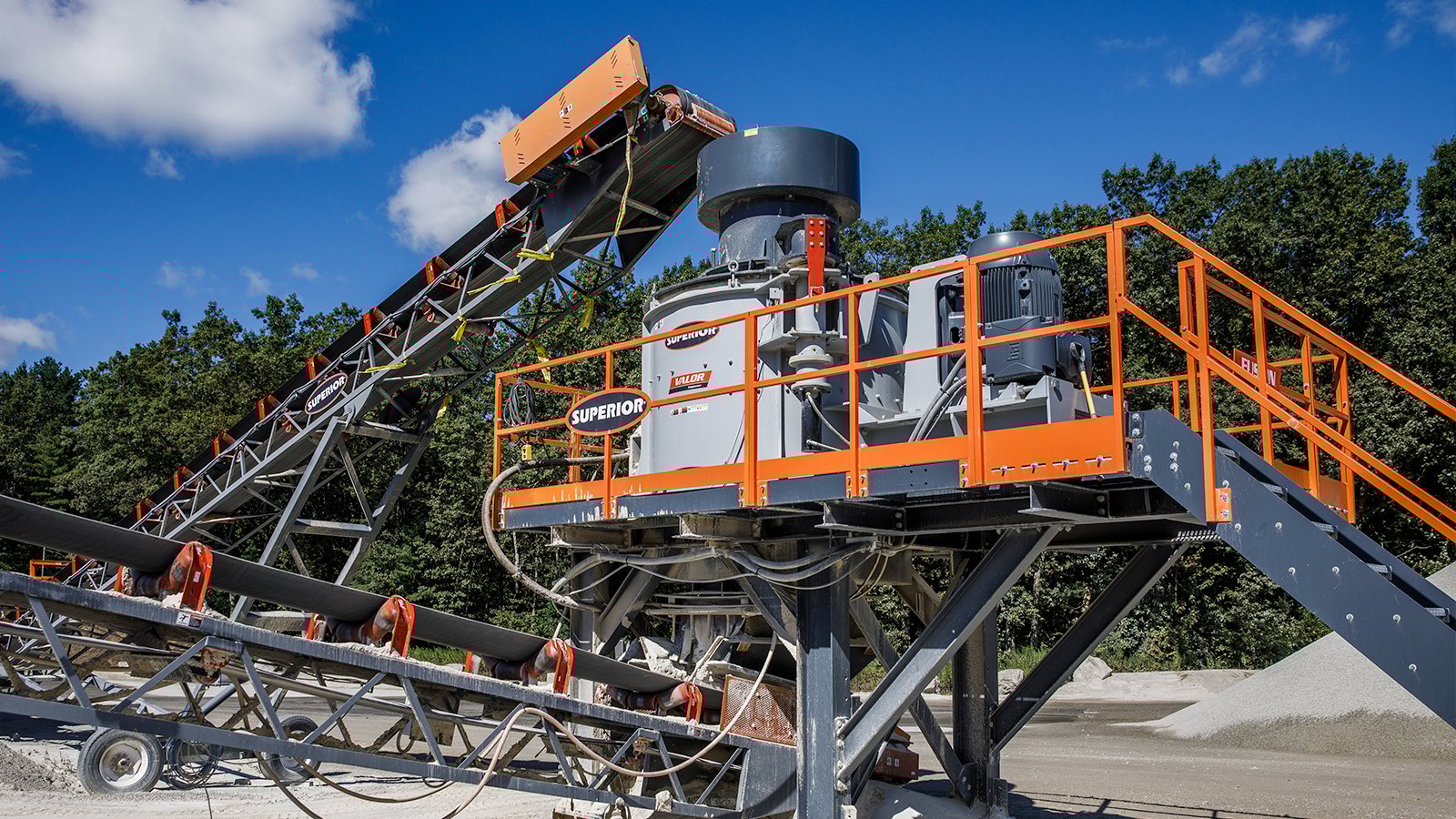 The Valor® VSI crusher reshapes incoming material into uniform, sand-grade particles ready for washing and classification.
Inside the Sand Circuit
The installation added a complete tertiary crushing and washing circuit downstream of the existing operation.
Stone enters at 1½-inch-minus where it is directed to a Superior VSI crusher. This shapes the material into particles required for spec.
Further downstream, an 8x20 wet Guardian® Horizontal Screen, screw classifiers, and dewatering screens separate and refine multiple products, including the in-demand septic and concrete sands.
A TeleStacker® Conveyor and 400-ft overland conveyor connect the crushing and washing circuits, while a transfer tower provides multiple feed points for long-term operation.
“As the quarry face advances, we can move the primary back into the face and feed the tower from multiple locations,” says Durkin.
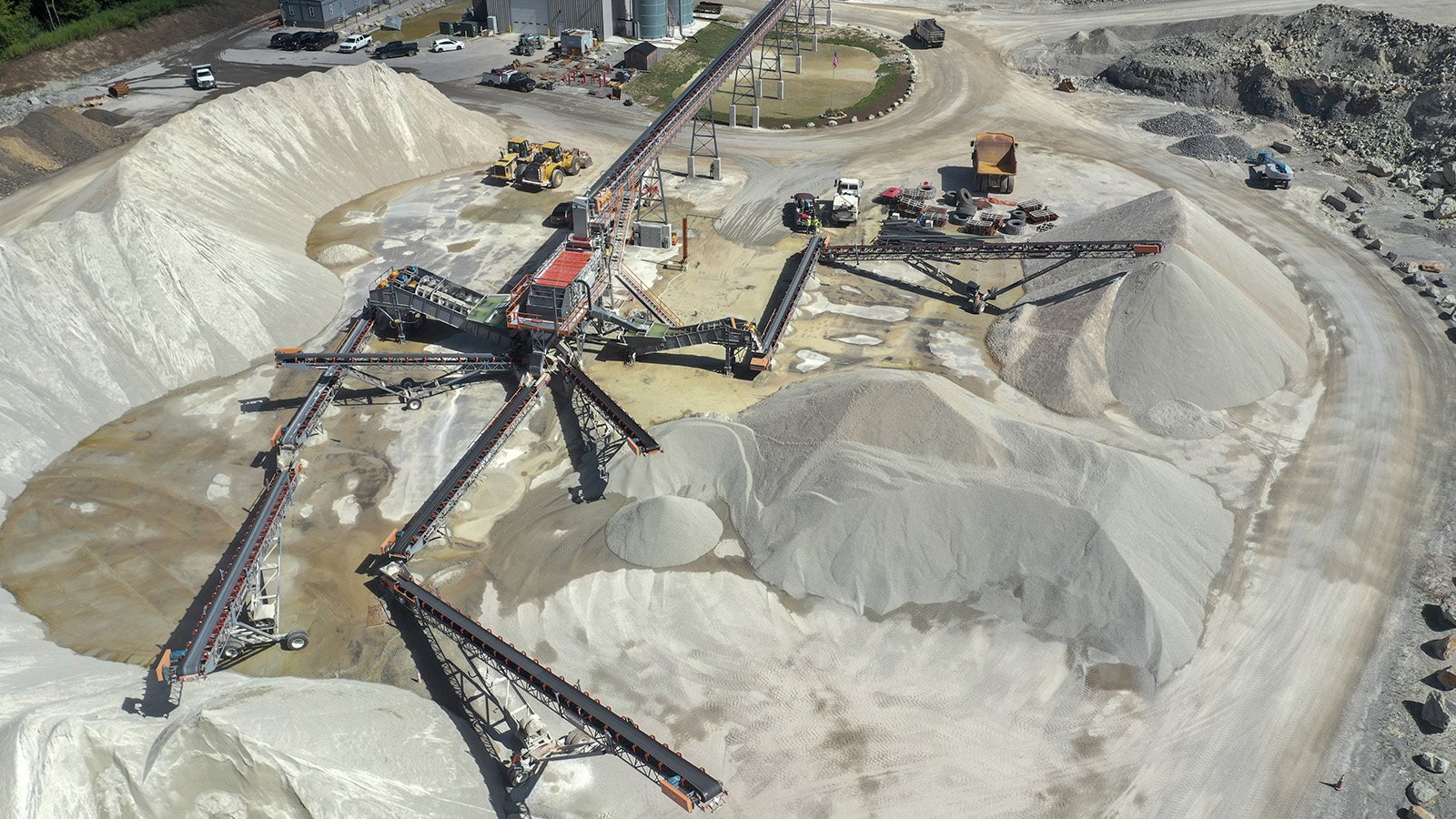 A bird’s-eye view of the wash plant shows the integrated system at work, with the 400-ft overland conveyor at the top linking the new circuit to the original operation.
No Ponds Required
The most distinctive feature of the new plant is its water recovery system.
Instead of settling ponds, the operation implements a high-rate thickener and recirculation system capable of recovering most of the processing water. Combined with dewatering screens and a 300,000-gallon underground storage tank, the system creates a closed-loop water cycle.
“Being able to recover about 95-percent of our water and eliminate the need for large settling ponds was ‘the Swiss Army knife’ in getting this permitted,” says Durkin.
Additional design elements include paved stockpile areas, which capture runoff and return it to the system, and a unique water storage system.
The plant's water is stored underground and maintains a consistent temperature of about 50°F, enabling production in conditions that would typically shut down wash plants in the Northeast United States.