

- Conveying
Share This Post
Replacing a failed pulley gets production moving again, replacing the same one repeatedly needs a different conversation.
A broken shaft, cracked end disc or recurring bushing problem may point to an issue that a like-for-like replacement cannot resolve. The failed component needs attention, but so do the loads and operating conditions around it.
Describe Exactly What Failed
"The pulley failed" is a starting point, but not a diagnosis.
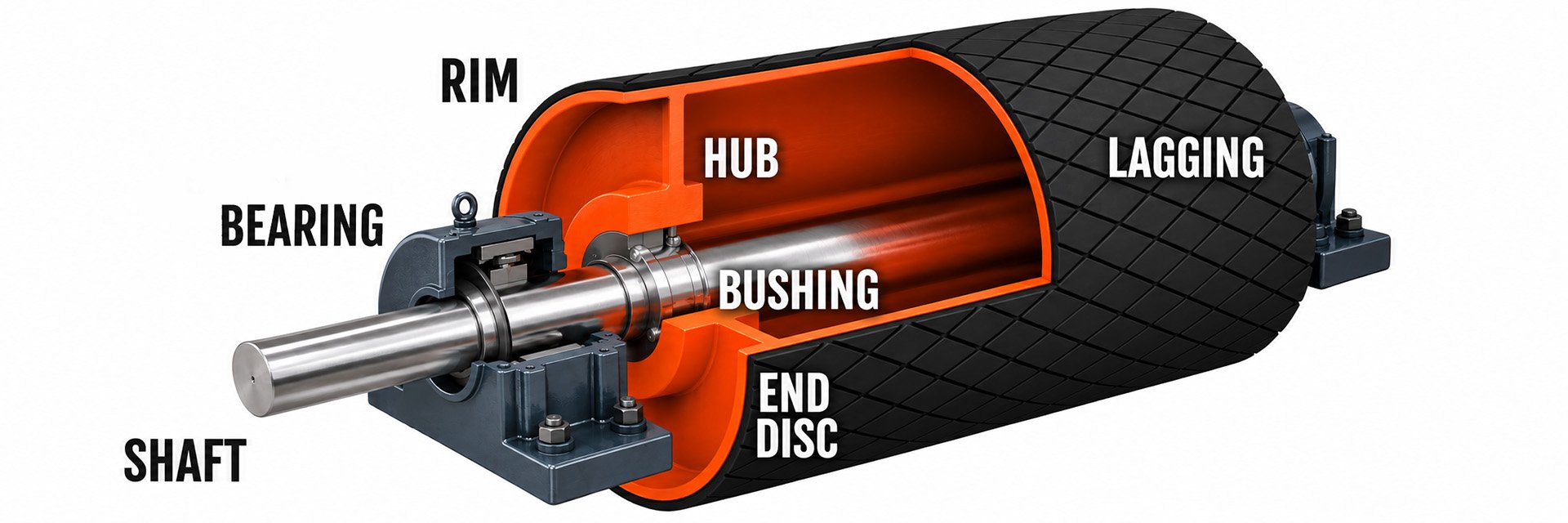
We need to identify whether the problem involved the shaft, end disc, hub connection, bearings or lagging. Record where the damage occurred and what was happening when it became apparent.
- Was the conveyor starting under load?
- Has material accumulated after a blockage?
- Have operating conditions recently changed?
Documenting the failure gives your manufacturer’s application team something to investigate beyond the replacement's diameter and face width. Retain the damaged parts when possible so the manufacturer can evaluate them.
Do not turn a recurring loose connection into an improvised welded connection. Address why it is loosening rather than removing its ability to move while leaving the underlying stress unresolved.
Look at the Conveyor It Operates
The existing pulley may have been selected for conditions that no longer describe the operation.
A change in capacity, belt specification, drive arrangement, operating speed or startup frequency warrants a review. A conveyor receiving intermittent discharge beneath a crusher — known as surge loading — faces different loading behavior from one receiving a steady feed.
Any conveyor take-up changes deserve particular attention. Adding counterweight to overcome slipping changes the forces acting on the system.
Give the reviewer the operating history, including changes that seemed unrelated when they were made. That history should help explain why a previously reliable position has become a repeat problem.
A Strong Shaft Can Still Deflect Too Much
Pulley shaft selection involves both strength and stiffness.
Strength concerns whether the shaft can withstand the applied stresses while stiffness determines how much it bends under load. Excessive bending, or deflection, can stress other parts of the pulley assembly even when the shaft itself has not broken.
That’s why a cracked end disc does not automatically mean the end disc was the only problem. Shaft deflection and the arrangement of the supporting bearings may need investigation too.
Selecting a higher-strength steel is not, by itself, a solution to excessive deflection. The assembly needs an engineering review that considers the shaft geometry, bearing spacing and applied loads together.
Don’t Let Dimensions End the Investigation
Two pulleys can share the same outside dimensions and have different internal construction, including shell thickness, end-disc design, hub connection and shaft details.
Duty names (i.e. CEMA or Mine) are also not enough to establish equivalence either. Ask what the proposed pulley is designed to handle rather than assuming that a heavier-sounding label resolves the problem.
This matters particularly when an emergency replacement has become the default part number. A pulley that was available during the last breakdown is not automatically the correct specification for the next one.
Give Engineers the Whole Picture
Useful application information includes pulley position, belt specifications, load and capacity, conveyor length and lift, drive power, take-up arrangement, operating hours and starting conditions. Include an assembly drawing or confirmed dimensions, especially the shaft and bearing arrangement.
Unknown information should be identified as unknown, not filled in with a guess. The pulley supplier can explain which measurements or operating details are needed to complete the review.
The goal is not automatically a bigger pulley. It is a correctly selected assembly operating within the conditions it was designed to handle.
Send this article to your inbox.
Want to read this later? Enter your info and we’ll email you a link to the article.