

- Washing
Share This Post
Send this Tech Tip to your inbox.
Want to read this later? Enter your info and we’ll email you a link to this article.
For aggregate and junior mining operations looking to optimize processing and stay adaptable to future changes, modular platform design offers a strategic advantage. Unlike traditional custom-built plants—which often require lengthy engineering phases, extended on-site assembly, and limit future flexibility—modular systems are designed with efficiency and adaptability in mind.
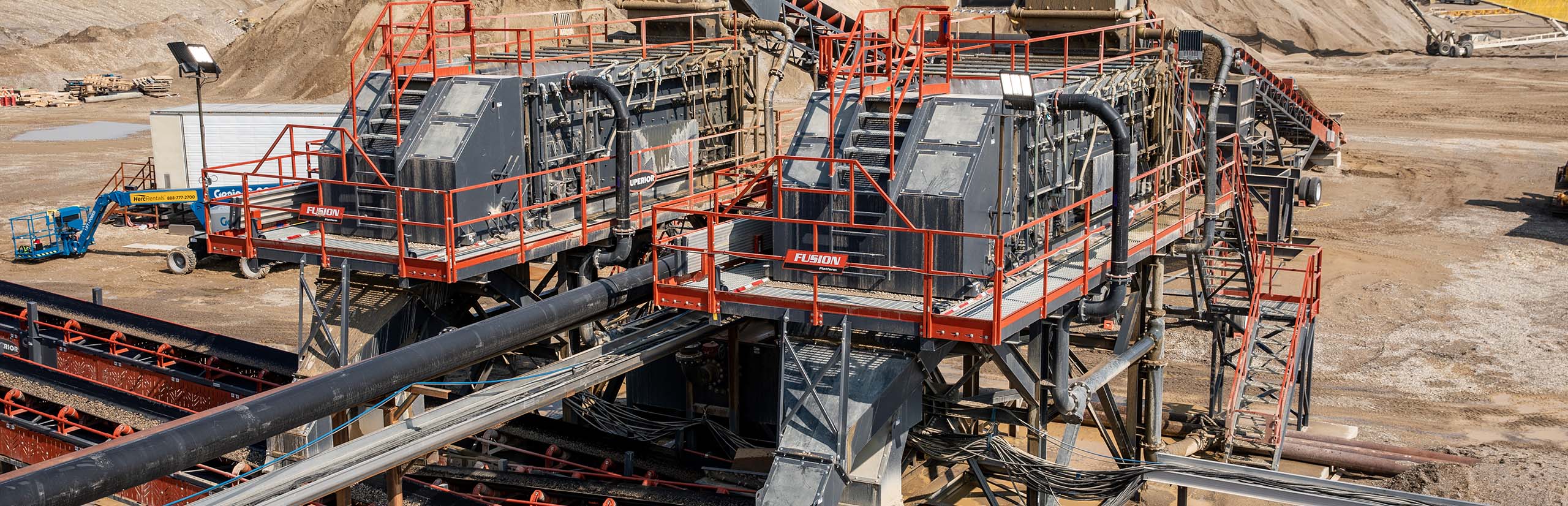
To meet these needs, Superior’s Fusion® Modular Platforms use standardized, pre-engineered components with flexible configurations. This modern approach streamlines design and construction, reduces setup time, and supports both new and existing operations. The designs feature bolt-together structures that accommodate crushers, screens, and washing equipment, while also improving access for operation and maintenance. Producers can mix and match modules to create a layout tailored to their application, without the time and cost of custom engineering.
“By definition, fusion means joining two or more things together,” says Mark Crooks, product manager at Superior. “Our main objective is to ensure a seamless process and smooth integration.”
The platforms are constructed from prefabricated sections that create distinct operational stations, such as a primary crushing station or a three-stage crushing and screening system, complete with stockpiling conveyors. In addition to the working components, maintenance areas, walkways, guardrails, and access stairs are also included.
Even though everything is designed to a standard, the system allows users to customize their own solution.
“Think about it like a modular home,” Crooks says. “When a home is custom-built, all of the elements are specifically made to suit that building—which means more time, money, and supplies are needed. A modular home, on the other hand, comes with pre-assembled pieces. The cost is lower, and the lead times are reduced, thanks in part to strategic stock. It’s factory-assembled to ensure fit-up, then disassembled for quick site delivery.”
Maybe it’s true in the modular home world too, but modular platforms can reduce costs by at least one-third when compared to traditional stick-belt stationary designs.
“The standardized, self-contained modules can be easily shipped and quickly assembled, allowing for faster setup,” Crooks says. “This not only reduces costs and saves time, but it’s also a practical option—especially if future relocation is in the plan.”
As processing requirements change or markets grow, modular platforms can be modified, expanded, or reconfigured—something that a bespoke solution couldn’t accommodate without a complete structural redesign. Crooks notes that additional modules can be integrated to accommodate new equipment or increased capacity.
“For example, an upgraded primary crushing station might be a first phase, with the addition of a scrubbing circuit to help break down clays from sand as they work through their reserves and property,” Crooks says.
These scalable designs readily adapt to customer site development, allowing producers to expand capacity quickly. Flexibility is introduced as owners or operators select different modules to suit their application.
“As communities grow and demand increases, it’s easier for customers to adjust their production capabilities.”
For operations that may need to relocate or redeploy equipment, modular platforms offer distinct advantages. Components can be disassembled, transported, and reassembled at new locations—preserving the initial investment and providing flexibility not available with permanent, custom-built structures.
For short-term projects and dry applications, Crooks explains, installing the base frame directly onto compacted earth—rather than a concrete foundation—is an option to facilitate easy relocation. In simple terms, he says, what’s installed on-site is the same as what’s taken down and shipped back on a trailer.
“We had a customer call us recently who we had been working with on a dam project,” Crooks says. “They’ll be finished soon, but have many other opportunities to use the existing modules, which is going to save them quite a bit of money.”
While the structural investment may be comparable to custom designs, the long-term cost benefits are substantial. Reduced engineering requirements, faster installation, simplified modification capabilities, and potential for reuse all contribute to a lower total cost of ownership over the system’s lifecycle.
“These platforms are designed to load on or in as few flatbeds or containers as possible, reducing shipping costs,” says Crooks. “And because they’re pre-engineered and pre-assembled, they install faster and require fewer crane lifts—saving both time and money. Repeatable processes like these make the system more cost-effective over the long term.”
As the aggregate industry continues to evolve, it will be increasingly important for producers to adapt, with scalability and flexibility becoming more critical to gain a competitive edge. Modular platforms help aggregate operations meet changing market demands while shrinking overall costs and implementation timelines.
“Modular platforms are like putting different items from a menu together for a really great meal!” Crooks says.
Want to read this later? Enter your info and we’ll email you a link to this article.
Talk to our team or find a dealer near you.