

- Crushing
Share This Post
Practical Tips for Better Liner Performance
When it comes to crushing efficiency and cost control, few components are as critical, or as overlooked, as cone crusher liners. These wear parts are major in determining output quality, machine uptime, and overall profitability. Yet many operations treat liner selection as an afterthought, relying on outdated specs or guesswork.
This guide was created to help you make smarter, more informed decisions about your liners, so you can extend wear life, reduce downtime, and maximize every dollar spent on your crushing circuit.
Picking Your Liner
- Pick Your Cavity
- Standard head -> For secondary applications with larger feed.
- Short Head -> For tertiary/quaternary applications and refined shaping.
- Know Your Feed Size
- Standard Cavity -> Feed should not exceed 80% of the crushing chamber feed opening (closed side)
- Short Head Cavity -> Feed size should not exceed 80%-100% of the crushing chamber feed opening (closed side), depending on machine size, material type, and crusher speed.
- Example -> If the max feed opening of the crushing chamber is 7", the max feed size of material should be 5.6" (80% of 7").
If the crusher is running a standard head in a closed circuit, please consult us for more guidance.
Feed size is determined by measuring the longest one-way dimension of the material
- Match the Reduction Ratio (feed size:product size)
- 6:1 -> Standard Head
- 4:1 -> Short Head
Choose a liner that gives the desired product size without over-crushing.
Changing Your Liners
Properly timed cone crusher liner changeouts don't just protect your equipment; they protect your bottom line. The timing of a changeout directly affects crushing efficiency, liner longevity, and overall plant performance. So, how do you know when it's time to make the switch? We asked Curt Theisen at Superior Industries, for his insight.
"Properly timed changeouts lead to greater crushing efficiency and liner performance," says Theisen. "The goal is to maintain the desired feed opening throughout the liner's life to get the most utilization out of each wear part."
Curt Theisen
Crushing Technical Support Engineer at Superior Industries
Utilization Targets: Don't Waste Your Wear Parts
In many operations, liners are tossed when they've only used up 35% of their life. That's a costly mistake. At a minimum, your target should be 50-55% liner utilization, meaning the work liner should weigh no more than half of its original installed weight.
To hit that target consistently, Superior recommends tracking wear in multiple ways. Choose the method that fits best with your setup, or better yet, use them together to build a reliable wear history.
Four Smart Ways To Time Your Changeout
Option 1: Adjustment Cap. Height is the most precise way to establish a baseline. When installed, each liner has a specific distance between the bottom edge of the adjustment cap and the top of the adjustment ring (aka the dust shell). As wear progresses, that dimension shrinks. When it reaches a predetermined height based on your liner configuration, it's time to change.
Option 2: Crushing Hours. Track how many running hours it takes to reach 50-55% liner wear. This approach works best once you've established a baseline from your first set of liners. From there, you can schedule preventitive maintenance before performance drops.
Option 3: Tonnage Produced. If you have access to belt scale data, track the total tons processed by each liner set. Once you know how many tons you typically get out of your liners, you can build predictive models around real material throughput, not just time.
Option 4: Throughput Reduction. Throughput monitoring is the. most performance-focused metric. As liners wear, crushers are adjusted to maintain a consistent closed-side setting, but the actual feed opening narrows. When that happens, tonnage starts to decline.
If you notice a 10% drop in throughput compared to your baseline, it's time to change the liners, even if they haven't reached 50% wear. The cost of lost production outweighs the extra wear life.
Monitor. Adjust. Optimize.
Wear performance isn't just about when you change, it's about whether you're using the right liner in the first place. Always evaluate your liner's ability to:
- Maintain desired feed openings
- Deliver a consistent product size
- Minimize downtime
- Maximize return per ton
Don't set it and forget it. Monitor your wear stats, track tonnage and hours, and weigh your liners. With a data-backed changeout strategy, you'll not only get more life out of your liners, you'll also get more value out of every crushing pass.
Liner Wear Guide
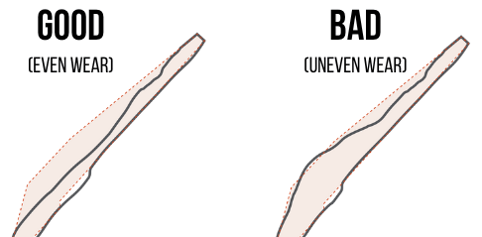
If you notice any of these irregular liner wear characteristics, you may be experiencing an issue with your application.
Feed Size is Too Large
- Material boils around the feed opening.
- The top or mid-section of the liner wears faster than the bottom.
- Feed opening bridges over, which prevents proper feed from entering the cavity.
- The crusher volume limit was exceeded at the minimal power draw.
Feed Size is Too Small
- The majority of crushing happens in the lowest part of the cavity.
- Bottom of liners wear faster than the top.
- Decreased production due to poor reduction ratio.
- The power and/or force limit of the crusher is exceeded at minimal volume.
- Risk of improper alignment of bearing cones.
Liner Self-Exam
- Cut through the mantle/bowl liner vertically from top to bottom.
- Trace the wear profile on a piece of paper or a chunk of cardboard
- Compare the worn profile to a new profile.
Balanced Load
A balanced load is achieved by feeding the machine with a well-graded feed that has no large gaps. This evens out the crushing load throughout the entire crushing chamber. A consistent, balanced load reduces stress caused to the crusher's internal parts and improves the wear life of the main components.
Choke Feed
A choke-fed condition is best for maximizing the life of the wear components. A choke-fed machine will typically wear out the liners evenly throughout the crushing chamber. Spotty or inconsistent feeds can cause premature wear, scuffing of the liners, and lead to inconsistent power draw and gradation
Send this Tech Tip to your inbox.
Want to read this later? Enter your info and we’ll email you a link to this article.