

- Screening
Share This Post
Send this article to your inbox.
Want to read this later? Enter your info and we’ll email you a link to the article.
Related Topics
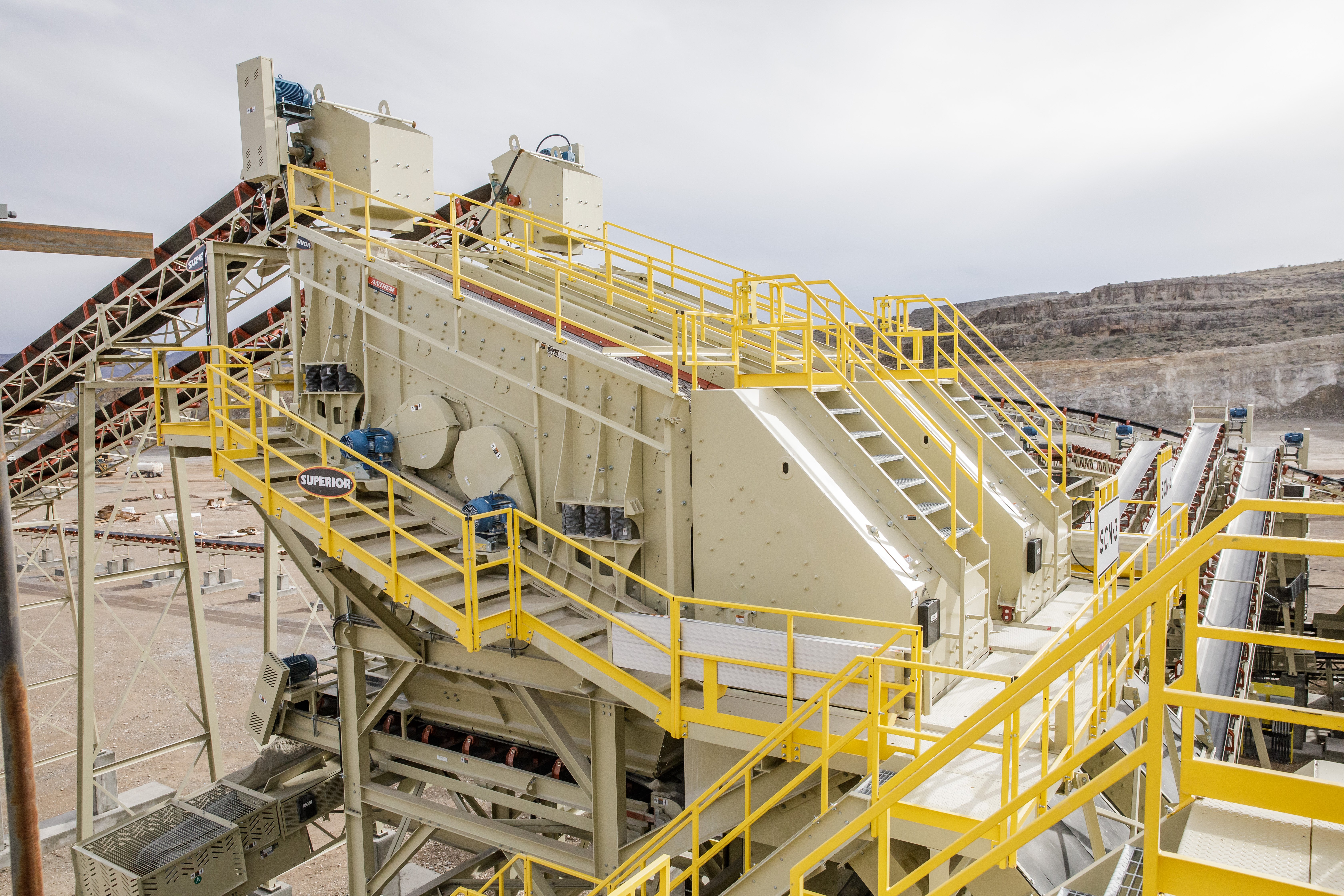
Maximizing screen performance requires getting off to a good start, and attention to detail on day one means more dollars made down the road.
When setting up a new screening circuit, there is much to consider, but first the vibrating screen’s operational settings must be adjusted and maintained to suit the specific application.
“Speed and stroke are two of the major factors to fine tune when setting up a screen,” says Ed Sauser, vibratory product manager at Superior.
He shares the following tips to achieve top screen productivity right from the start.
Speed (RPM) and stroke (amplitude) work together in standard formulas that offer optimum screening efficiency in a specific application. In very general terms, finer screening requires less stroke and higher speed, while coarse separation needs increased stroke and lower speed.
Proper speed for a given application creates a material travel rate and a bed depth that allows finer materials to pass through. In combination with proper speed, the screen’s stroke must be set at a level that’s strong enough to prevent plugging without risking damage to any of the machine's components.
Most manufacturers use the Vibrating Screen Manufacturers Association (VSMA) formula to determine optimum screen capacity, which is the calculated capacity per square foot of screen area in tons per hour. Additionally, the VSMA handbook offers a detailed, illustrated resource for step-by-step screen setup.
A quick manual check with a stroke card can reveal whether your vibrating screen is running at optimal amplitude and motion.
Often overlooked is the potential downside of higher speeds. Sauser cautions that “speed kills” as it can compromise the life of the machine. With vibratory equipment, bearing life is affected exponentially by speed.
Producers may not realize that if they reduce speed by 10-percent – and can still meet specifications – that they can potentially double bearing life on vibratory equipment. Alternatively, if speed is increased by 10-percent, bearing life may be cut in half. Don't run vibratory equipment
any faster than you have to. Obviously if material is blinding or pegging, more speed is required. But if you can do the job with less speed, it’s better for machine wear life.
Feed size, particle shape, moisture levels, media selection, size of openings, desired cut, tons per hour, and more – each little detail of the application affects optimum screen setup and performance.
Sauser stresses that too often producers are trying to do too much with one screen or with one deck. Efficient screening will be possible if material is well distributed so the depth of material on an individual deck is not too great because smaller particles may take too long to reach and pass the screening surface. Generally, a depth to media opening should be 4-6:1 at the discharge end. For example, 6:1 depth with ¼” opening media is only 1.25” deep.
Define your application in detail and make sure the settings you choose support maximum screening efficiency and machine life.
Want to read this later? Enter your info and we’ll email you a link to the article.
Talk to our team or find a dealer near you.