
Max Belt Capacities Calculator
Estimate conveyor belt capacity using belt width, trough and surcharge angles, material density and belt speed.
Conveyor Specifications
Enter your belt and material properties to calculate maximum and recommended planning capacity.
Your Belt Capacity
Estimated capacity based on the selected conveyor and material inputs.
CEMA standard cross-sectional capacity (100% loading).
Superior recommends planning at no more than 80% of theoretical capacity.
Engineering Notes
Calculation Assumptions
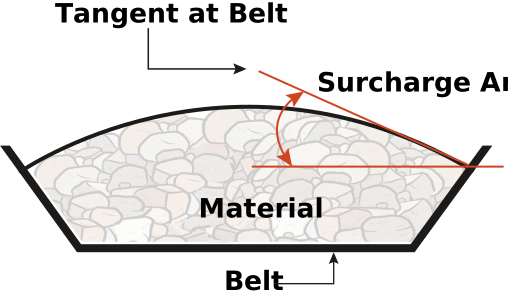
- Capacity uses CEMA lookup values for the selected belt width, trough angle and surcharge angle.
- Published table values assume 100 PCF bulk density, 100 ft/min belt speed and 100% standard cross-sectional loading.
- Capacity scales proportionally with the entered bulk density and belt speed. Surcharge angles between 5° table increments are linearly interpolated.
- The 80% planning capacity is a recommendation, not the maximum theoretical capacity.
Intended Use and Limitations
Results are preliminary estimates for dry bulk material handling on a horizontal conveyor. Incline reductions, loading conditions, material behavior, spillage and other site-specific factors require engineering review. Lump-size guidelines are simplified references, not a substitute for material-specific design.
Engineering Source
CEMA, Belt Conveyors for Bulk Materials, 7th Edition, Second Printing, Tables 4.42–4.44. Capacity calculation and interpolation follow the Superior Field App reference implementation.